 AUTOMATA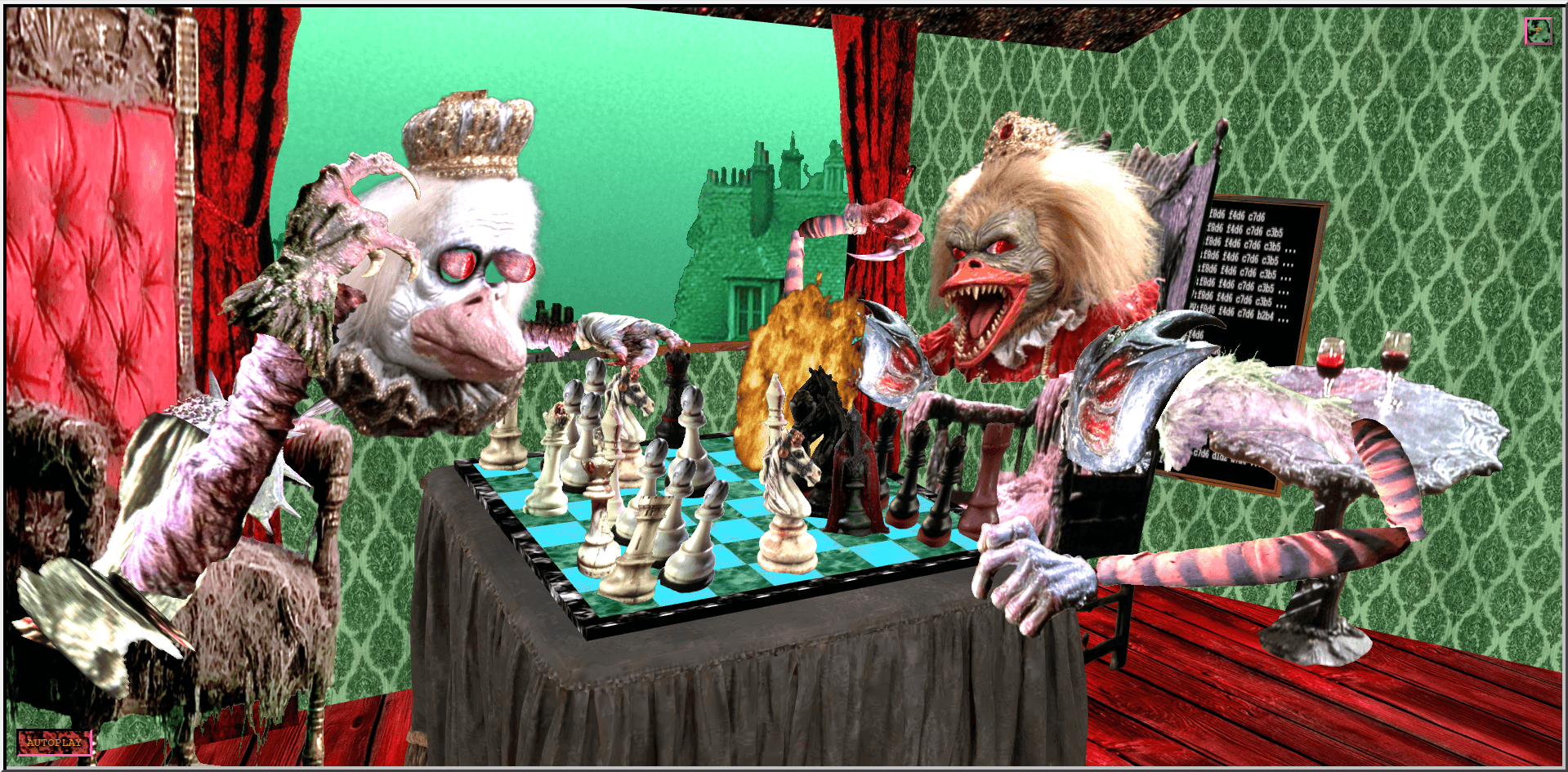
Ten browser worlds,
each with its own algorithm,
its own visual system,
its own character
Oculart is the life’s work of Geoffrey Lillemon: ten autonomous browser-based art worlds built over twenty-five years of treating the web as a primary artistic medium. Each world occupies its own domain, runs on its own system, is driven by its own data.
One is driven by a chess AI. Another by SETI signal data. Another by a procedural sound system. Another by spectral harmonics. Together they form a body of work expressed across distinct characters and experiences — the act of watching a match, tuning a fork, reading a book, conducting a storm.
The worlds aren’t isolated. They’re connected systems. The chess engine in one work can influence how a piano player performs in another, which controls the tempo of a lightning simulation, which drives an orchestra. One expression of energy translating through different artworks, becoming one ultimate body of work. Collectors who acquire these works become participants in this interconnected ecosystem.
Experience the Works
Best viewed on desktop. Each artwork runs in real time — every session is unique.
Possession of Chess
Two bird-like monarchical figures sit across a chess table, their every gesture sculpted by the artist. A JavaScript chess engine (Stockfish.js) plays against itself in real time, and each computational decision triggers the emotive posture of the figures — creating a perpetual match of art viewing and game watching.
1/1 — AvailableIn Conversation
On the browser as a stage
In the late 90s, early 2000s, as artists we entered a new kind of expression in art. The polyrhythmic abilities of web design tools infused an animation into the life force of an artist canvas, thus turning on the voltage of what art can be. Suddenly what we made could be published outside of the traditional gallery realm and reach a more widespread audience of like-minded people — and with that there was an intimacy between those in the role of art spectator and those as fellow artists. An introvert’s cage placed on the grand stage.
On Oculart as an interconnected world
When working locally, in such a small space, not giant paintings, or big sculptures, you get closer to the source. It’s almost the closest you can get your brain and soul into the machine. Oculart is this introspective, thought-provoked canvas that has deep personal meaning. I don’t collaborate on it because it is a safe space that offers a clear path to a source of inspiration.
On real-time vs. video
Real-time always felt more alive than video. Video is fixed. Real-time has infinite variation. It breathes but has compositional control like a painting — this polyrhythmic timing allows systems that drift slightly out of sync, compositions that have a life of their own. And that tension between control and autonomy is where I feel like Dr. Frankenstein.
On what Oculart means
I used to have a house that looked like the work in Oculart, and it made me insane to live in it. So what’s better than visiting the asylum from a clickable distance?
History of Oculart
Oculart didn’t start as a platform or a project. It started as a practice — one artist, one browser, and the conviction that the web could be a stage for living art. Here is its arc.
Late 1990s
Origins in Flash and early web tools. Geoffrey Lillemon begins creating browser-based art as tools like Flash first make real-time animation possible on the web. The work is surreal, dreamlike, murky — more impression than interface. It possesses what early observers described as “a certain hellish quality” and a sense of spatial depth built from static images, collage, and subtle animation.
2002
Oculart gains international recognition. The site is archived in the Web Design Museum as part of the “Golden Age of Web Design” and catalogued on net-art.org as part of the net art canon. Lillemon is invited to the Banff New Media Institute in Canada at age twenty — the residency where he begins merging fine art with science and programming to create digital experiences.
2006
Champagne Valentine and Random Studio. Lillemon co-founds Champagne Valentine, the pioneering digital studio that defines the visual language of the early internet. He joins Random Studio, where over the next fourteen years he shapes interactive retail and exhibition environments for Gucci, Chanel, and the Getty family. Throughout this period, Oculart continues as his private, personal practice — the inverse of the commercial work.
2016
Department of New Realities at Wieden+Kennedy. Lillemon co-founds the Department of New Realities at Wieden+Kennedy, pushing the boundaries of experiential design and emerging technologies in the advertising world. His commercial practice continues to absorb and reflect the experiments happening in Oculart.
2020s
Oculart V2: ten browser worlds in WebGL. Lillemon rebuilds Oculart from the ground up as ten distinct browser-based worlds using modern WebGL and generative systems. Each world has its own domain, its own visual language, its own driving algorithm. The chess engine in Possession of Chess. The MIDI-Bach system in Canon to the Eclipse. The SETI signals in Vaudeville Seti. Together they form an interconnected constellation where one work can trigger another.
2026
AUTOMATA presents Oculart as collectible one-of-ones. For the first time, each Oculart world is presented as an original one-of-one artwork available for acquisition. Each work is paired with a bespoke physical art computer — a dedicated device that hosts the work and can plug into any display. The browser world becomes tangible. The question “how do you collect a browser world?” gets an answer.

Geoffrey Lillemon
Contemporary Digital Artist · Amsterdam
For over 25 years, Geoffrey Lillemon has worked at the intersection of art, code, VFX, and performance, contributing to the early wave of browser-based and interactive experimentation that treated the internet not as a platform for distribution, but as a primary artistic medium.
Operating under the moniker Oculart, he develops generative ecosystems in which code, CGI, and procedural logic function as expressive materials. Technology is often perceived as cold and optimized; Lillemon embeds themes of romance, theatricality, and vulnerability into computational systems. His works don’t simulate life — they perform.
He co-founded Champagne Valentine, the pioneering digital studio that defined the visual language of the early internet, and served as Co-Founder and Executive Creative Director of the Department of New Realities at Wieden+Kennedy. His work in experiential design at Random Studio (2006–2020) shaped interactive retail and exhibition environments for Gucci, Chanel, and the Getty family.
- Stedelijk Museum — Permanent Collection, Amsterdam
- Centre Pompidou — Invité d’Honneur, Paris
- Grand Palais Immersif — Quantum Facelift, Paris
- Van Gogh Museum — Expansive Digital Commission
- Nxt Museum — Simulation in Blue, Amsterdam
- Eye Film Museum — Cinekid, Amsterdam
- Museo Tamayo — Mexico City
- MOCA Pacific Design Center — Los Angeles
- Museum Boijmans Van Beuningen — Rotterdam
- Visionaire / Cadillac House — New York
Beyonce, U2, Coldplay, Lady Gaga, Miley Cyrus (Bangerz World Tour), Travis Scott, Snoop Dogg, Nicki Minaj, MGMT
Gucci, Chanel, Iris van Herpen, Rick Owens, Jean Paul Gaultier, Bernhard Willhelm, Tim Burton, Adult Swim
Selected Work & Collaborations
- Miley Cyrus — Bangerz World TourStage Direction
- Simulation in Blue — Nxt MuseumMuseum Commission
- Quantum Facelift — Grand Palais ImmersifSpatial Installation
- The New Freak ShowHolographic Performance
- Gucci, Chanel, Iris van HerpenFashion & Experiential
- Stedelijk Museum — Permanent CollectionMuseum Collection
Inquiries
ameesia@automata.artEach Oculart browser world is a one-of-one original artwork, available for acquisition. Art computer prototype reveal coming soon. Contact Ameesia for pricing and availability.